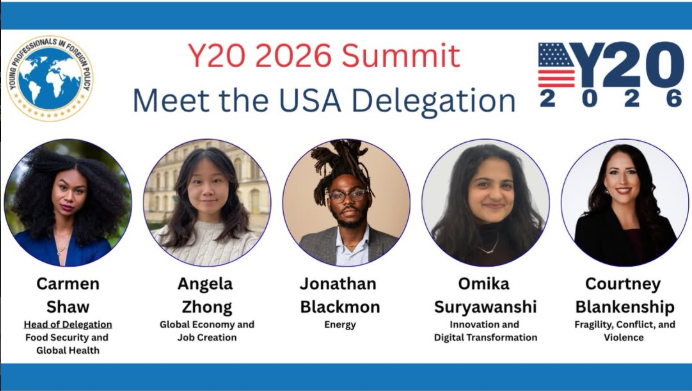
Q&A: Jonathan Blackmon
Energy
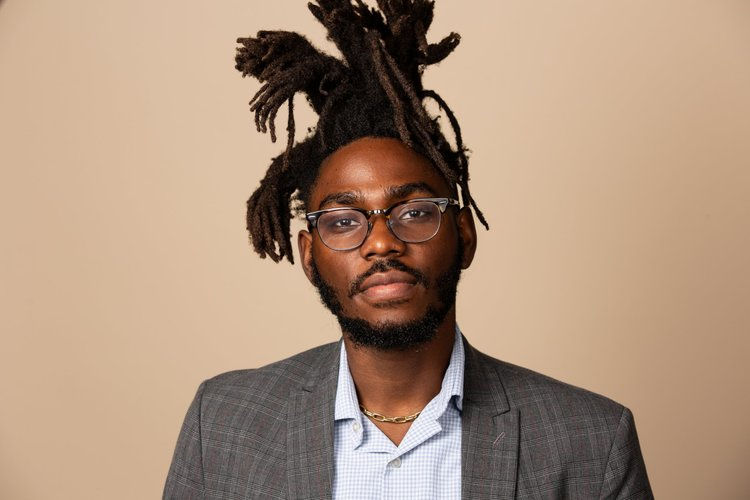
Jonathan Blackmon currently teaches political science at Florida Agricultural and Mechanical University. As a recipient of the Gilman Scholarship, he cataloged Afro-descendant archives in Uruguay, and connected Latino communities to their public lands in Washington state. Jonathan holds an M.A. in International Affairs from American University.
Q: How did you hear about the Y20 Summit and what made you apply to be a delegate?
I became a member of YPFP in my first year of graduate school at American University, and this is when I first learned about Y20. The Y7/Y20 ecosystem has been on my radar since the before-times (pre-COVID), but it was my move out of DC to take a professor role in the south and recent changes to the federal bureaucracy that drove me to apply in 2026. I wanted to be a voice for young people away from large metropoles in the second and third tier cities within the United States, particularly since I am a Professor at an HBCU in a mid-sized city of less than half a million people. It is important to make sure a diverse range of voices are heard from across the expanse of our great nation.
Q: What has been your proudest accomplishment as an American Delegate so far?
So far my proudest moment has been working on the energy sovereignty language within my respective track (Energy), and encouraging my fellow delegates to think creatively. We have been given a gift to create policy recommendations on behalf of our countries, with free rein to design the world we would like to see. I am pushing for a vision where states have localized energy infrastructure in a way that insulates them from global energy market price shocks. As I write this, the language we are using has yet to be finalized, but I'm very hopeful about what we have produced collectively.
Q: How do you want to leverage this opportunity to build your career?
I would like to continue pursuing opportunities to represent the United States, Afro-descendant communities, and the parts of the United States that are often an afterthought in US foreign policy on a global stage. The conflict inherent in multilateral negotiations is an arena I can see myself doing well within, and I attribute this to a strong-held desire to continue serving the American people.
Q: Why is it important for young people to participate in the Youth G20 Summit and other opportunities that can shape foreign policy/What advice would you give to future applicants?
For anyone interested in a career in national security, international climate policy, becoming a diplomat, etc., Y20 is a wonderful platform to channel your energy into a diplomatic process that leads to a document with real political weight among like-minded peers from around the world. This is a substantial time commitment, but the reward is finding community, pushing policy initiatives that you genuinely care about, and being able to look back and say that you made a difference with your voice. The sweat equity is worth it, and the advice I would give a future applicant comes from an old southern analogy. "Can't never could, until he tried." Essentially, if you do not try to make an impact, you will never know what you can truly accomplish.
About the 2026 Y20 Summit 🌍
As the official youth engagement group of the G20, the Y20 Summit is the only formal channel through which youth voices are integrated into the G20's official agenda. With the United States holding the 2026 G20 Presidency, this year's highly anticipated Y20 Summit will take place in Washington, D.C., from August 10–14, 2026.
Experience Y20 Week! 🎉
Curious to learn more about the official Y20 communiqué and what happens after the negotiations wrap up? Join us for a full week of Y20 programming, culminating in our closing panel: Y20 Week: From Consensus to Action.
This panel event is a unique opportunity to gain key insights from foreign policy leaders, learn about the delegate experience, and network with fellow young professionals. Together, with high-level policy experts from BPIA and the Kettering Institute, United Nations Foundation, GSIS, and YPFP, we will reflect on the week's intense negotiations, unpack the youth consensus, and explore how to bridge the gap from the Y20 to actionable G20 policy.
Date & Time: Friday, August 14, 2026 | 6:00 PM — 8:00 PM EDT
Location: Peterson Institute, 1750 Massachusetts Ave NW, Washington, DC.